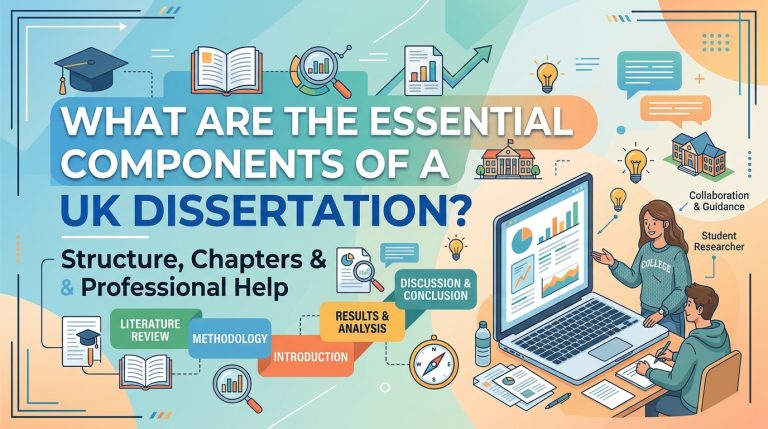
Writing a UK dissertation involves much more than reaching a required word count. Every major section has a specific purpose, and the quality of the final project depends on how well those sections connect to the same research question. A strong dissertation should take the reader logically from the problem being investigated, through the existing research and chosen methodology, to the findings, interpretation and final conclusions.
For students who are unsure where to begin, dissertation help online UK can be useful for understanding the structure, planning individual chapters and identifying where a developing project needs more attention. The important point is that dissertation requirements are not identical across every university or discipline. UK guidance commonly includes an introduction, literature review, methodology, findings or results, discussion, conclusion, references and supporting material, but the precise chapter order can vary. The University of Manchester, for example, describes this as a typical rather than universal structure, while University of Edinburgh guidance also shows differences between theory-based, humanities and empirical dissertations.
If you are already searching for professional dissertation help, this guide explains what each essential component is expected to accomplish, what commonly goes wrong and where specialist support may be useful without losing control of your own research.
Table of Contents
- What Is a UK Dissertation?
- What Is the Standard UK Dissertation Structure?
- How Long Should a UK Dissertation Be?
- Title Page and Preliminary Pages
- Abstract
- Introduction
- Literature Review
- Research Methodology
- Results or Findings
- Discussion
- Conclusion and Recommendations
- References and Bibliography
- Appendices
- Sample UK Dissertation Structure
- Dissertation Pre-Submission Checklist
- How to Build a Dissertation Step by Step
- When to Use Professional Dissertation Help
- Frequently Asked Questions
What Is a UK Dissertation?
A dissertation is an extended piece of independent academic research completed around a focused question, problem or topic. Unlike a normal essay, it requires the student to manage a longer research process in which the literature, methodology, evidence and argument need to remain connected from beginning to end.
This is why students often find dissertations difficult even when they are confident in their subject knowledge. The challenge is rarely one chapter in isolation. A change to the research question can affect the literature review, methodology and discussion, while weaknesses in data collection may limit what can reasonably be claimed later in the project.
Students looking for online dissertation help usually need support because one of these connections has become difficult to manage. The most useful support therefore begins with the project as a whole before focusing on individual chapters.
Need Help Structuring Your Dissertation?
Send your brief, research question and current draft to Your Writing Hub and discuss support for the chapter or research decision that is slowing your progress.
UK Dissertation Structure: What Every Major Section Should Include
There is no single dissertation template that every UK university follows, but several components appear consistently across research-based programmes. Manchester guidance, for example, identifies the introduction, literature review, methodology, results, analysis or evaluation, conclusion, bibliography and appendices as a typical sequence, while other programmes may combine results and discussion or organise chapters thematically.
| Dissertation Component | Main Purpose | What the Reader Should Understand |
| Title Page | Identify the research project | Topic, student and institutional details |
| Abstract | Summarise the whole study | Purpose, method, main findings and conclusion |
| Introduction | Establish the research problem | What is being investigated and why |
| Literature Review | Evaluate existing knowledge | What is known, debated and still unresolved |
| Methodology | Explain the research design | How and why the research was conducted |
| Results/Findings | Present the evidence | What the research discovered |
| Discussion | Interpret the findings | What the results mean in relation to the question and literature |
| Conclusion | Bring the research together | What can reasonably be concluded |
| References | Document sources | Where the academic evidence came from |
| Appendices | Store supporting material | Additional evidence or research documentation |
A dissertation help company UK students approach should always ask for the university handbook or module guidance before recommending a structure, because subject conventions and local rules take priority over generic templates.
How Long Should a UK Dissertation Be?
There is no national UK dissertation word count. Length varies by qualification, department, discipline and university, which is why students should check their own handbook before using an online example as a target.
University of Edinburgh guidance notes that many undergraduate dissertations are around 10,000 words, while Warwick’s MSc Economics guidance currently sets a maximum of 8,000 words for its dissertation. At postgraduate research level, the limits can be much larger; Bristol, for example, lists an 80,000-word maximum for a standard PhD, while Sheffield publishes faculty-specific guidance that commonly falls between 75,000 and 100,000 words for doctoral work.
| Level or Example | Illustrative Guidance |
| Undergraduate dissertation | Often around 10,000 words in some programmes |
| Taught Master’s dissertation | Programme specific; some may be below or above 10,000 words |
| Research Master’s thesis | Often substantially longer, depending on university and discipline |
| PhD thesis | Common limits may extend to approximately 75,000–80,000+ words depending on faculty |
These figures should be treated as examples rather than universal rules. If you are considering dissertation help online UK, the first document to share should be your official dissertation handbook because it normally determines the length, chapter requirements, formatting and submission rules that matter for your project.
Dissertation Title Page and Preliminary Pages
The title page appears simple, but it normally contains information required by the university and should therefore follow institutional guidance exactly. This may include the dissertation title, student name or identification number, programme, institution, submission date and word count.
Depending on the course, preliminary material may also include a declaration, acknowledgements, table of contents, list of figures, list of tables, abbreviations or other formal pages. These sections are not academically complex, but inconsistencies at the front of the document can make an otherwise well-developed dissertation look unfinished.
Where formatting has become difficult late in the project, professional dissertation help may focus on checking headings, page numbering, contents pages, figure numbering and general consistency rather than changing the research itself.
Dissertation Abstract: Sell the Value of the Research in Limited Space
The abstract is a compact overview of the complete dissertation and is normally written after the main study has been completed, even though it appears near the beginning.
A useful abstract should allow the reader to understand the research problem, aim, general approach, principal findings and overall conclusion without reading the full dissertation first. University of Manchester guidance on dissertation abstracts emphasises clarity, accuracy and comprehensiveness and describes a structure that covers the topic, aim, major findings and conclusion.
Students frequently make the abstract too similar to the introduction, but the two sections perform different jobs. The introduction opens the research problem and explains what the study intends to investigate, whereas the abstract reports the project in miniature after the work has been completed.
If you are thinking, “i need someone to write my dissertation”, the abstract is a good example of why full outsourcing is rarely a useful solution: this section needs to accurately represent research decisions and findings that you should understand well enough to explain. A better approach is to use feedback or editing support to make your own summary more precise.
Dissertation Introduction: Establish the Problem and Research Direction
The introduction gives the reader the first complete picture of the study. It should establish the subject, explain the problem, identify the research aim and questions and show why the study is worth undertaking.
UK academic guidance commonly expects dissertation introductions to establish context, identify a problem or research gap, state aims or questions, summarise the research design and give the reader an overview of the dissertation structure.
A commercial write my dissertation service may promise to produce an introduction quickly, but an effective introduction depends on decisions that influence every later chapter. If the problem statement is vague or the research question does not match the methodology, the difficulty will return in the findings and discussion.
A strong dissertation introduction normally makes the following points clear within a connected narrative: what the study investigates, why the topic matters, what specific problem or gap has been identified, what the project aims to achieve and how the dissertation is organised.
Not Sure Whether Your Research Question Is Focused Enough?
Your Writing Hub can review your question, aims and current proposal before the rest of the dissertation becomes difficult to realign.
Literature Review: Show What the Research Already Knows
The literature review should not be a long sequence of article summaries. Its purpose is to evaluate what is already known about the topic, identify patterns and disagreements and establish the intellectual basis for the study.
The University of Manchester describes the literature review as a way of locating the research within the broader body of knowledge and identifying gaps rather than simply summarising everything written on the topic.
A strong literature review normally moves between sources rather than discussing one source at a time. Themes, theoretical perspectives, methodological differences and conflicting findings can all provide useful ways of organising the chapter.
Students using dissertation help online often need support here because the volume of reading becomes difficult to control. The solution is usually not to add more sources automatically, but to decide which literature genuinely contributes to the research question and what argument the review is building.
When reviewing your literature chapter, ask whether the reader can clearly see what is already established, what remains contested and how your study fits into that conversation.
Methodology: Explain and Justify How the Research Was Conducted
The methodology chapter explains how the research was designed and why the chosen approach was suitable for answering the research question.
Depending on the study, this may include the research philosophy, design, sampling, participants, data sources, data collection procedures, analytical techniques, ethical considerations and limitations. For empirical projects, enough detail should normally be provided for the reader to understand exactly how the research was carried out.
UK university guidance commonly places emphasis on justification as well as description. Manchester guidance expects students to outline the research design and justify the methods and techniques selected, while Leeds guidance notes that methodology should accurately describe research activity and the procedures used.
This is also where professional data analysis help or data analysis help online may become relevant for quantitative, qualitative or mixed-methods projects, particularly when students need support understanding which analytical technique fits the research design or how outputs should be interpreted.
The software itself should never become the methodology. SPSS, R, Python, NVivo or another platform is only the tool used to carry out part of the analysis; the chapter still needs to explain why the underlying method was appropriate.
Results or Findings: Present the Evidence Clearly
The findings chapter reports what the research produced. Its precise format depends on the methodology and discipline.
A quantitative project may present descriptive statistics, inferential tests, tables and figures, while qualitative work may be organised around themes, categories, participant accounts or patterns identified during analysis. Documentary or secondary research may require another structure entirely.
The main rule is to distinguish the evidence from the interpretation where the programme expects separate results and discussion chapters. Leeds guidance, for example, describes results as an objective summary of findings, with explanation of their significance reserved for discussion.
Good online dissertation help at this stage should therefore focus on whether findings are presented accurately, whether tables and figures are understandable and whether every result included has a clear relationship with the research question.
Discussion Chapter: Explain What the Findings Actually Mean
The discussion is where the dissertation moves from reporting evidence to interpreting it.
A strong discussion explains how the findings answer the research question, whether they support or challenge previous studies and what the results mean within the wider academic or practical context. This is also the place to address unexpected findings, competing explanations and relevant limitations.
University of Edinburgh guidance describes the discussion as the opportunity for students to show what their project means in relation to the literature, even when the final data do not definitively prove the original hypothesis.
This chapter is frequently where students searching “write my dissertation for me” feel most stuck, because interpretation requires more than assembling sources or presenting data. It depends on understanding the research well enough to explain why a result matters.
Instead of handing that reasoning away, use professional dissertation help to test the logic of your interpretation, identify unsupported claims and strengthen the relationship between findings and literature.
Dissertation Conclusion: Give the Research a Defensible Ending
The conclusion should bring the dissertation back to the research question and explain what can reasonably be concluded from the study.
It is not simply a shortened version of the discussion. A good conclusion draws together the central findings, explains the contribution of the project, acknowledges important limitations and may identify implications or directions for future research where appropriate.
The final chapter should not suddenly introduce an entirely new body of evidence. Instead, it should show the reader what the project has established after considering the literature, methodology and findings together.
If you are comparing dissertation help company UK options, look for support that helps you keep the conclusion proportional to the evidence rather than encouraging exaggerated claims simply to make the project sound more important.
References and Bibliography: Make Every Source Traceable
Every source cited in the dissertation should appear in the reference list according to the referencing style required by the university.
Harvard, APA, OSCOLA, Vancouver, Chicago and other systems have different rules, and individual universities may also publish their own variations. Consistency therefore matters just as much as knowing the general style.
Students who have reached the final editing stage may benefit from academic proofreading services or an online proofreading service to review citation consistency, formatting and language. The purpose should be to correct presentation and clarity while preserving the student’s academic argument and authorship.
Appendices: Include Supporting Material Without Overloading the Main Chapters
Appendices hold material that supports the dissertation but would interrupt the main discussion if included in full.
Depending on the project, this may include questionnaires, interview guides, additional tables, coding frameworks, ethics documents, detailed calculations or supplementary figures.
An appendix should not become storage for material that was never discussed in the dissertation. Every important piece of evidence still needs to be explained in the main text, while the appendix provides supporting detail where necessary.
Sample UK Dissertation Structure
Consider a dissertation titled:
“How Does Remote Working Influence Employee Productivity in UK Small and Medium-Sized Enterprises?”
A coherent structure might look like this:
| Section | Example Content |
| Title | Remote working and employee productivity in UK SMEs |
| Abstract | Brief summary of aim, method, findings and conclusion |
| Introduction | Background to remote work, problem statement, research aim and questions |
| Literature Review | Remote work theory, productivity research, autonomy, communication and management practices |
| Methodology | Qualitative interviews with employees and managers from selected UK SMEs |
| Findings | Themes emerging from participant responses |
| Discussion | Comparison of findings with previous research and theory |
| Conclusion | Main answer to the research question, limitations and implications |
| References | All cited literature |
| Appendices | Interview questions, participant information and additional material |
The important feature is not the exact chapter title but the alignment between the research question, literature, objectives, methodology and findings. A dissertation can look professionally formatted and still feel weak if these elements are not connected.
Need Your Dissertation Reviewed Chapter by Chapter?
Your Writing Hub provides dissertation help online UK for planning, literature review development, methodology review, data interpretation, editing and supervisor-feedback integration.
Button: Get Professional Dissertation Help
UK Dissertation Pre-Submission Checklist
Before submitting, use the following checklist to identify problems that are easier to correct before the final upload.
| Check | What to Confirm |
| Research Question | The question is focused, researchable and answered by the study |
| Aim and Objectives | Every objective contributes directly to the project |
| Literature Review | Sources are synthesised rather than simply summarised |
| Methodology | Research choices are explained and justified |
| Ethics | Relevant ethical requirements have been addressed |
| Findings | Results are presented accurately and clearly |
| Discussion | Findings are interpreted against literature and research questions |
| Limitations | Important methodological or practical constraints are acknowledged |
| Conclusion | Claims remain within what the evidence supports |
| References | All in-text citations appear in the reference list |
| Tables and Figures | Numbering, titles and references in the text are consistent |
| Appendices | Supporting material is relevant and correctly labelled |
| Formatting | University requirements for margins, headings, pagination and file type are followed |
| Proofreading | Grammar, terminology and formatting have received a final review |
| Word Count | The dissertation complies with the programme’s official rules |
This checklist should be adapted to your own university requirements rather than treated as a replacement for the official handbook.
How to Build a UK Dissertation Step by Step
Step 1: Confirm the University Requirements
Before drafting chapters, check the dissertation handbook, word count, referencing style, required components, ethics process and submission rules. This prevents avoidable structural changes later.
Step 2: Refine the Research Question
A question that is too broad usually creates problems across every later chapter. Make sure the topic can be investigated realistically within the time, evidence and methods available.
Step 3: Build the Literature Base
Search systematically enough to understand the main debates, theories and research gaps relevant to the project. Organise literature around themes or arguments rather than simply collecting sources.
Step 4: Design the Methodology
Choose the design, sample, data sources, collection methods and analytical approach according to the research question. Methodological convenience should not be the only justification.
Step 5: Complete the Research and Analysis
Collect or assemble the required evidence and apply the agreed analytical method carefully. Keep records of decisions and changes because these may need to be explained later.
Step 6: Present the Findings
Decide which results are necessary to answer the question and present them using text, tables, figures or themes as appropriate.
Step 7: Develop the Discussion
Interpret the findings rather than repeating them. Compare the results with previous research and explain similarities, differences, implications and limitations.
Step 8: Write the Conclusion
Return directly to the research question and explain what the project has established. Keep claims proportionate to the evidence.
Step 9: Complete the Abstract and Preliminary Pages
Once the study is complete, write an accurate abstract and finish the contents pages, lists, declarations and other preliminary material.
Step 10: Edit Against the University Guidance
Use the official handbook as the final checklist. Review structure, referencing, language, tables, figures and formatting before submission.
Professional Dissertation Help: What Support Should Actually Include?
Students search phrases such as “can i pay someone to write my dissertation”, “i need someone to write my dissertation” and “write my dissertation for me” when the project has become difficult to manage, but completely outsourcing assessed research can create serious academic-integrity problems and leaves the student unable to explain or defend the work.
A more useful write my dissertation service should therefore be understood as structured academic support rather than anonymous replacement authorship. That may include refining a research question, organising literature, discussing methodology, interpreting supplied data, reviewing individual chapters, integrating supervisor feedback, proofreading or improving formatting while keeping responsibility for the research with the student.
If you need dissertation help online, the first question should not be “Who can take the whole project away from me?” but “Which part of the project is preventing me from moving forward?” Once that problem is identified, support can be much more focused and useful.
Why Choose Your Writing Hub for Online Dissertation Help?
Your Writing Hub provides support around the dissertation you are actually completing rather than relying on a generic chapter template. We begin with your university guidance, research question, current progress and supervisor feedback so the work can be reviewed in context.
Students using our online dissertation help can discuss support with proposal development, literature reviews, methodology, data interpretation, findings, discussion, editing, proofreading, formatting and chapter coherence. The scope can focus on one difficult section or a wider review depending on what the project needs.
We also keep the process clear before work begins. You can share the brief, required deliverables and deadline, discuss the level of support available and review the proposed cost before deciding whether to proceed.
Frequently Asked Questions About UK Dissertation Structure
What Are the Main Components of a UK Dissertation?
A typical research dissertation may contain a title page, abstract, introduction, literature review, methodology, findings or results, discussion, conclusion, references and appendices. The exact structure should always follow your university and departmental guidance because disciplines vary.
Does Every UK Dissertation Need a Literature Review?
Most research dissertations engage substantially with existing literature, although the location and format of that review can differ. Some programmes use a dedicated literature-review chapter, while others integrate the literature throughout thematic chapters.
Are Results and Discussion Always Separate Chapters?
No. Some programmes separate findings from discussion, while others combine them, particularly in qualitative or discipline-specific dissertation formats. Edinburgh guidance explicitly notes that dissertation structures differ by discipline and topic.
How Long Should the Introduction Be?
There is no universal percentage that applies to every dissertation. The introduction needs enough space to establish the context, research problem, aim, questions, significance and structure without consuming words needed for the main analysis. Follow departmental guidance where chapter allocations are provided.
What Is the Most Important Dissertation Chapter?
There is no single chapter that can compensate for weaknesses everywhere else. The quality of the dissertation depends on alignment between the research question, literature, methodology, findings and discussion.
Can I Get Professional Dissertation Help with One Chapter?
Yes. Professional dissertation help can be limited to a defined stage such as the literature review, methodology, data interpretation, discussion, editing or supervisor-feedback review without involving the entire dissertation.
Can Online Dissertation Help Include Data Analysis?
Where data analysis forms part of the agreed support, students can discuss professional data analysis help for appropriate methods, interpretation and presentation of supplied data. You should still understand the method used and be able to explain the results.
Can Someone Write My Dissertation for Me?
Searching “write my dissertation for me” often reflects pressure rather than the best academic solution. Universities expect submitted dissertations to represent the student’s own work, so support should focus on guidance, feedback, analysis assistance, editing and research development rather than undisclosed replacement authorship.
Can I Pay Someone to Write My Dissertation?
If by “can i pay someone to write my dissertation” you mean purchasing assessed work to submit as your own, that can conflict with university academic-integrity requirements. Paid support is better used for legitimate services such as tutoring, editing, proofreading, methodological guidance, statistical support or feedback on your own draft.
How Do I Choose a Dissertation Help Company UK Students Can Trust?
A dissertation help company UK students consider should be transparent about scope, pricing, confidentiality, qualifications, revision terms and academic-integrity boundaries. It should ask for your university requirements before recommending a generic solution.
Final Thoughts
The essential components of a UK dissertation are not difficult to name, but making them work together is where most of the challenge lies. The introduction should establish a focused problem, the literature review should position the research within existing knowledge, the methodology should justify how the question was investigated, the findings should present the evidence clearly and the discussion should explain what that evidence means.
There is also no substitute for checking your university’s own dissertation guidance. Word counts, chapter structures, formatting rules and even the relationship between findings and discussion can vary significantly between programmes.
If one chapter is preventing the rest of your dissertation from moving forward, Your Writing Hub offers dissertation help online UK students can discuss at the stage they actually need it, from early planning and literature review development to methodology, data interpretation, editing and final presentation.